

Discover Turkey - the other Holy Land
DID YOU KNOW…
this about Antioch?
- The term “Christian” was first used to describe the followers of Jesus in the ancient city of Antioch, located in what is now modern-day Turkey.
- According to the New Testament book of Acts (Acts 11:26), it was in Antioch that the disciples were “first called Christians”.
- This designation marked a significant development in the identity of the early Church, distinguishing believers in Christ from other Jewish groups.
Read MoreLess
Why Antioch?
- After the martyrdom of Stephen, the first Christian martyr, many believers fled persecution in Jerusalem and spread out to various regions, including Antioch in Syria.
- Antioch was a large, cosmopolitan city with a significant Jewish population as well as many Gentiles (non-Jews), making it fertile ground for the spread of Christianity beyond its Jewish roots.
- The early Christian community in Antioch included both Jews and Gentiles, and it was here that the gospel was actively preached to Gentiles, marking a key moment in the expansion of the Christian faith.
Key Figures and Events
- Barnabas, sent from the Jerusalem church to Antioch, was impressed by the Gentile conversions and brought Saul (Paul) from Tarsus to Antioch to help teach the new believers.
- Paul and Barnabas taught in Antioch for about a year, strengthening the church and encouraging its growth.
- The name “Christian” likely originated as a term used by outsiders to describe the followers of Christ in Antioch, reflecting their distinct identity.
Significance
- Antioch became a major center for early Christianity and missionary activity, serving as the launching point for Paul’s missionary journeys.
- The church at Antioch is often seen as the first truly mixed community of Jewish and Gentile believers, symbolizing the universal nature of the Christian message.
- In summary, the followers of Jesus were first called “Christians” in Antioch around A.D. 40, a city that played a pivotal role in the early spread of Christianity and the formation of its identity as a distinct faith separate from Judaism.
Where is Antioch situated in modern day Turkey?
Antioch, known in modern times as Antakya, is situated in the Hatay Province of south-central Turkey. It lies in a fertile valley on the Orontes River, near the Mediterranean coast, approximately 12 miles (19 kilometers) northwest of the Syrian border. The ancient city of Antioch was founded in 300 BC by Seleucus I Nicator and became a major center of Hellenistic, Roman, Byzantine, and early Christian history. The modern city of Antakya now stands partly on the site of this ancient city.
Coordinates of Antioch/Antakya:
Latitude: 36°12′17″N (approximately 36.2°N)
Longitude: 36°10′54″E (approximately 36.18°E)
Antakya is the administrative capital of the Province of Hatay, which is the southernmost region of Turkey, and it has a rich historical legacy related to Christianity.


Biblical Turkey
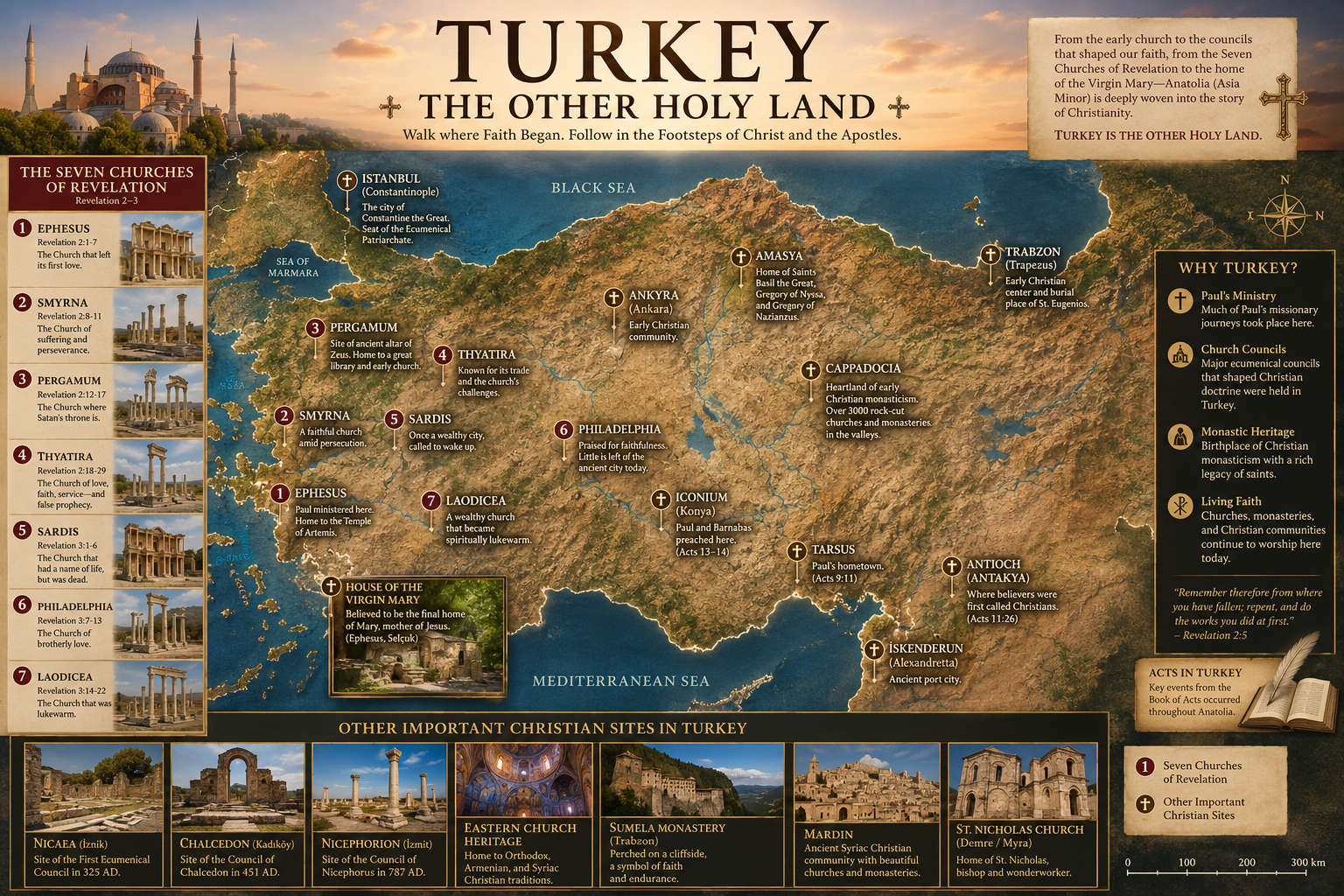
Turkey – the other Holy Land
Ancient Turkey (Anatolia / Asia Minor) was not only a cradle of early Christianity, hosting foundational churches, councils, and apostolic missions that shaped Christian doctrine and practice. It was also home to a number of key biblical sites reaching back to the days of Noah. Hence its reputation as “the other Holy Land”. Despite the decline of Christianity in the region over centuries, Turkey’s rich Christian heritage endures through its archaeological sites, historic churches, and ongoing religious significance for multiple faiths. This makes Turkey a unique and vital land for understanding early Christianity and its historical development.
Read MoreLess
Key Historical and Religious Highlights
- Centers of Early Christianity and the Pentarchy: Two of the five ancient patriarchates of the Pentarchy-the highest-ranking episcopal sees of early Christianity-were located in what is now Turkey: Constantinople (modern Istanbul) and Antioch (modern Antakya). Antioch is historically significant as the place where followers of Jesus were first called “Christians” and where Saint Peter established one of the earliest churches, carved into a cave.
- The Seven Churches of Asia: These are seven early Christian communities mentioned in the Book of Revelation, all located in western Turkey. They include Ephesus, Smyrna (Izmir), Pergamon, Thyatira, Sardis, Philadelphia, and Laodicea. Each church received a specific message in the biblical text, reflecting their spiritual strengths and weaknesses. Ephesus, for example, was a major Roman city where Apostle John lived and where the Virgin Mary is said to have spent her last days in a house that remains a pilgrimage site today.
- Apostolic Activity: Apostles Paul, Peter, and John are closely linked with Asia Minor. Paul preached in cities such as Perge, Derbe, Lystra, Psidian Antioch, Ephesus, and Konya. John is believed to have lived in Ephesus with the Virgin Mary and died there after his exile on Patmos. Peter settled in Antioch and established the first church there. Philip, another apostle, was martyred in Hierapolis.
- Ecumenical Councils: The first seven Ecumenical Councils, foundational to Christian doctrine and recognized by both Eastern Orthodox and Western churches, were held in present-day Turkey. The First Council of Nicaea (325 AD), which produced the Nicene Creed, took place in İznik (Nicaea).
- Christian Sites and Heritage: Turkey hosts numerous ancient Christian sites:
- Hagia Sophia in Istanbul, once the largest church in the world for over a millennium and a symbol of Byzantine Christianity.
- The House of the Virgin Mary near Ephesus, a revered pilgrimage site for Catholics, Orthodox Christians, and Muslims.
- The Cave of the Seven Sleepers in Ephesus, linked to a legend shared by Christian and Muslim traditions.
- Cappadocia region, known for its extensive early Christian monastic communities carved into rock formations, with many churches and frescoes.
- Historical Context: Christianity became the official religion of the Roman Empire in 380 AD under Emperor Theodosius I. Despite this, the region experienced fluctuations in Christian dominance, especially during the Byzantine era and later the Ottoman period. The Ottoman conquest led to a gradual decline of Christianity as Islam became dominant, though Christian minorities such as Armenian Apostolic, Greek Orthodox, and various Catholic communities persisted.
- Old Testament Background: The country is also home to biblical sites such as Ur of the Chaldeans and Mount Ararat, traditionally believed to be the resting place of Noah’s Ark. It was also home to several ancient peoples mentioned in the Old Testament, most notably the Hittites mentioned in Genesis, Joshua, Numbers, and 2 Kings. Two of the four rivers mentioned in the Creation account—the Euphrates and Tigris—originate in eastern Turkey. The city of Harran, located in southeastern Turkey, is where Abraham received his call to greatness. This marks Turkey as a starting point for one of the most important figures in biblical history, linking the land to the patriarchal narratives of the Old Testament.
- Current Christian Presence: Today, Christians are a minority in Turkey, with an estimated 120,000 Christians among a population of about 73 million. The country remains officially secular, with constitutional guarantees for religious freedom, though the role of Islam in society remains a subject of debate.
Turkey offers you the opportunity to engage in a spiritual journey of faith, reflection, and connection with sacred history. The landscape, ancient ruins, and holy sites create an immersive environment for prayer, learning, and renewal. Modern-day Turkey is a secular state and disposes of a well-developed tourism infrastructure, making it accessible and welcoming to Christian visitors and pilgrims.

Sultan Ahmed Mosque
The Blue Mosque, also known as the Sultan Ahmed Mosque, is a historic architectural masterpiece in Istanbul, Turkey, famed for its stunning blue İznik tiles and six towering minarets. Built in the early 17th century, it remains an active place of worship and a popular attraction for visitors from around the world. The Blue Mosque is situated in Istanbul, Turkey, in the historic Sultanahmet district, directly across from the Hagia Sophia.


Dolmabahçe Palace
Dolmabahçe Palace, located on the European shore of the Bosphorus in Istanbul, was built in the 19th century as the main administrative center of the Ottoman Empire. It blends traditional Ottoman architecture with European styles such as Baroque, Rococo, and Neoclassical. The palace is renowned for its opulent interiors, including the world’s largest Bohemian crystal chandelier and lavishly decorated halls.


Obelisk of Theodosius
The Obelisk of Theodosius is an ancient Egyptian monument located in Istanbul’s Hippodrome, originally erected in Luxor around 1450 BC. It was transported to Constantinople by the Roman Emperor Theodosius I in the 4th century AD. Carved from pink granite and covered in hieroglyphics, the obelisk stands as a symbol of imperial power and historical continuity.
News about Turkey
Today's news
Jailed Kurdish PKK leader says armed struggle with Turkey is over, calls for members to disarm
Jun 5, 2025
As Entire Middle East Shifts, Kurdish Rebels End 4 Decades of War with Turkey
May 5, 2025
Turkey in Syria
May 3, 2025
Is it safe to be Christian in Turkey?
Subscribe to our newsletter